MAX KENNEDY
PANTRY PANIC



Work in the galaxy's hottest diner
Pantry Panic is a short VR experience made by a four person team where players must prepare as many ingredients for a chef within a two minute period. The project was selected to be showcased at the 2026 QUT Open Day.
The game is designed as a VR beginner friendly game, with no complex actions required. The final version of our game is a chaotic and out-of-this-world cooking simulator where it is only you against the clock.
TEAM MEMBERS
Ash Tarsilli (Designer, Artist)
Asher Johnston (Programmer)
Max Kennedy (Designer)
Xavier Mackay (Programmer, Artist)
DURATION
4 weeks of pre-production
9 weeks of development
ENGINE

Unity
CONTRIBUTIONS
UI Design
VFX
Level Design
PRE-PRODUCTION
The first few weeks of pre-production on Pantry Panic was a combination of learning VR development for the first time and understanding the various affordances of VR games and experiences. As my first experience developing a game in VR I realised that I was going to have to approach gameplay interactions and design from a different lens.
Initially, the concept that I pitched to the team was a VR space racer. The game utilised the quest controllers as a throttle and joystick as well as players being able to remain seated throughout gameplay as an accessibility option and affordance to reduce the player moving around with the headset. Ultimately, my concept was not picked by the rest of the team and another teammates concept for a twist on a VR cooking-simulator was chosen.


DEVELOPMENT
Our team did not have a specialised artist for this project, however; we were able to work around this by having the game's art style be simplistic and have members of the team with previous experience with modelling and texturing contribute elements to the game.
As I was the most comfortable with using Unity's GUI system, I was in charge of designing the game's UI. Through experimentation and internal playtesting within the group, world-space UI was chosen compared to screen-space or overlay UI as the cameras on the headset are situated in a way that having to look to the corners of the screen to find UI information can be uncomfortable and cause dizziness.
I started by workshopping some holographic information panels using a simple scrolling shader to move a texture made in photoshop along the face of a plane. Playtesters found it difficult to read the tutorial text under the shader and unfortunately further refinements and subsequent playtests were yielding the same results. The element was scrapped in favour of using ghost guides and interaction sockets to teach players where objects could be placed and interacted with in the world.


REFINEMENT
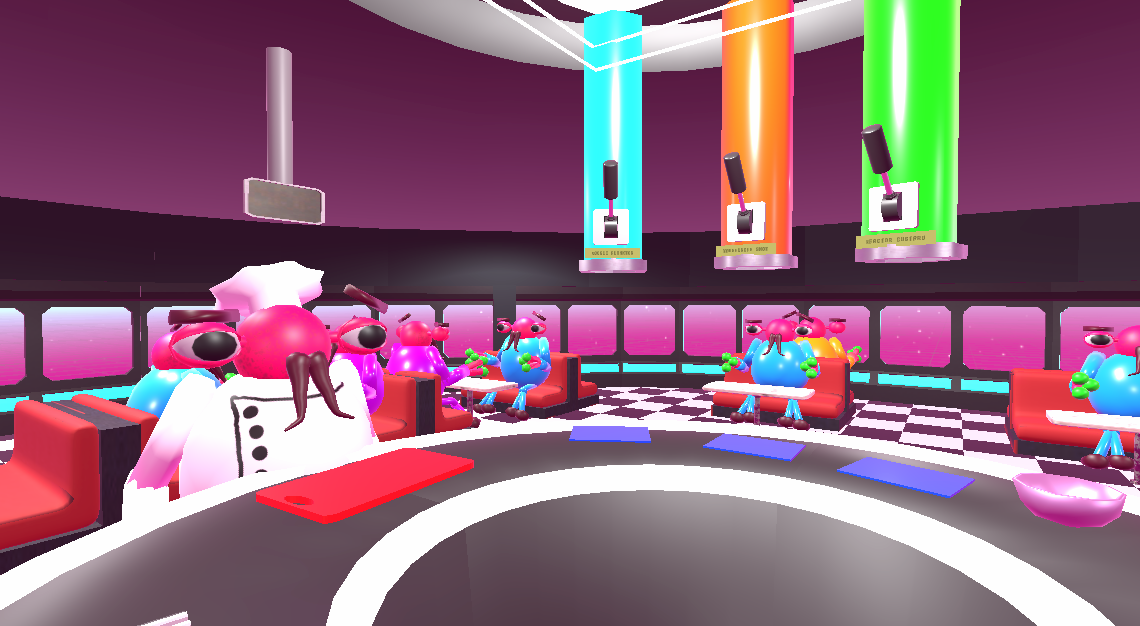
The original level design for Pantry Panic included a 2m x 2m floor, three walls with shelves and a window to throw completed ingredients at the chef. Although the play space and the game's aesthetics were being communicated correctly to players, data from testing showed that their was expressions of discomfort with the space being somewhat claustrophobic. I presented a re-designed play space to the team where the walls surrounding the player were removed and the shape of the counter was changed to be spherical. Together with populating the now open environment with various customers and diner booths, player's responses showed higher levels of immersion within the game world and zero responses about the level being claustrophobic.
My favourite part of the game I was able to work on during this section of the project was definitely the flame particle system for whenever a player added an ingredient to the grill.